
Lola didn’t open jot because she needed a feature.
She opened it because she needed to think.
It was late. She’d just finished binge-watching Heated Rivalry - the kind of show that slips under your skin and rearranges something. What started as entertainment turned into deep doom-filled introspection. There was something about the tenderness between the characters, the freedom, the lack of rigid gendered scripts, that left her unsettled in the best way.
So she did what she always does when her brain won’t quiet down.
She opened a blank entry on jot.
Other diary apps might have asked her to pick a mood emoji.
Happy? Sad? Neutral?
That wasn’t going to cut it.
What Lola was feeling didn’t fit inside a dropdown menu. She wasn’t “sad.” She wasn’t “happy.” She was curious. Disrupted. A little destabilised. Questioning whether some of her past relationships had been shaped more by social conditioning than by genuine desire.
So she wrote it exactly like that: messy, philosophical, half-formed.
She wondered:
Do I actually like certain relationship dynamics, or have I absorbed them?
Is desire something you choose, or something you inherit?
Can you reshape patterns that feel predetermined?
She didn’t tidy it up before hitting save.
And that’s where jot is different.
Most journaling apps stop at storage. They archive your thoughts and call it self-care.
jot doesn’t stop there.
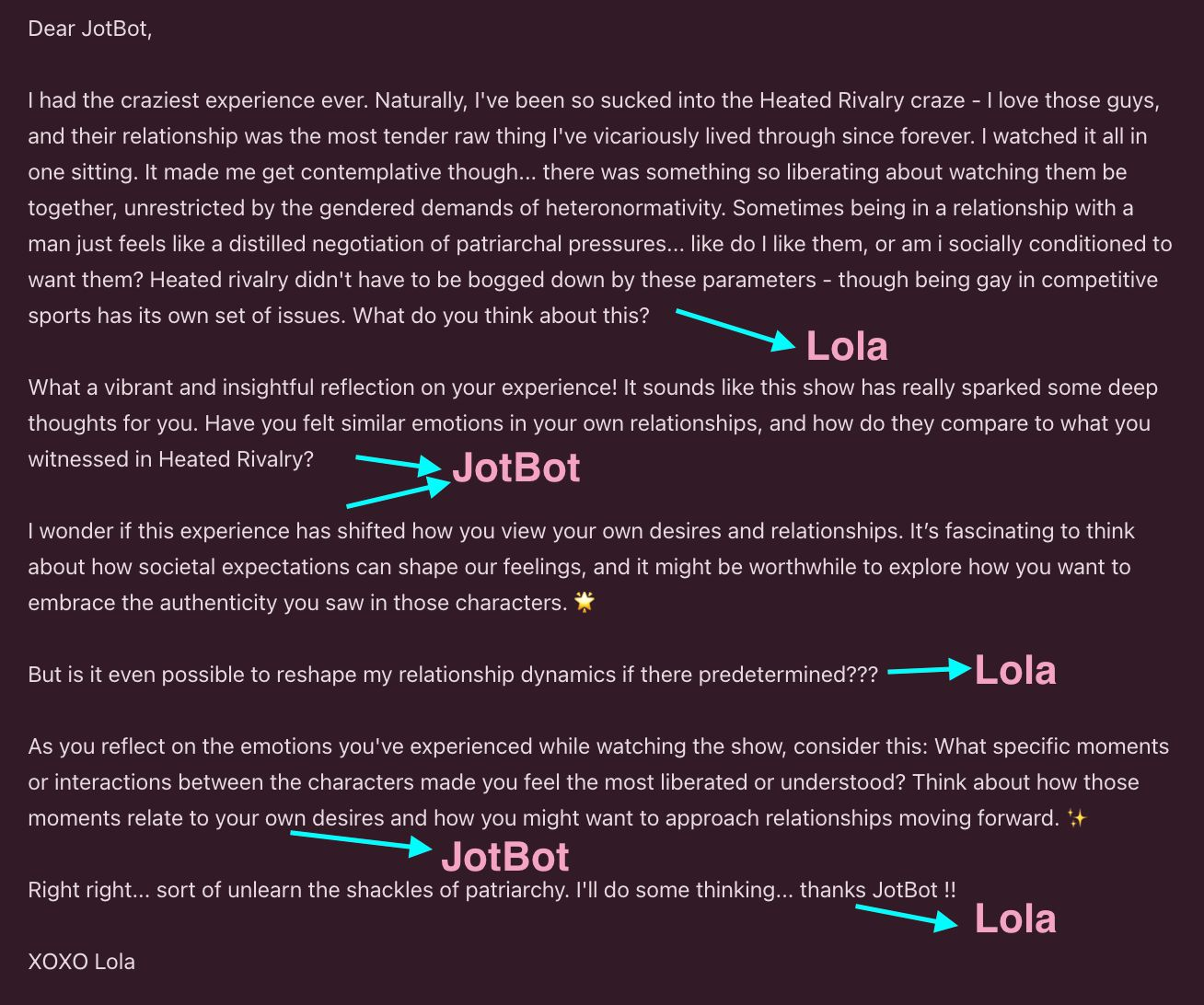
When Lola finished writing, JotBot responded, not with advice, not with therapy-speak, not with mora
l judgement, but genuine curiosity.
It reflected the depth of her contemplation.
It asked how those feelings compared to her lived relationships.
It gently nudged her to explore specific moments that made her feel liberated or constrained.
There was no “here’s what you should do.”
There was no “you’re overthinking.”
There was an invitation to dig deeper.
That’s the difference.
It would be easy for an AI journaling app to overstep and to rewrite her thoughts, summarise her feelings into bullet points, flatten nuance into something digestible.
JotBot doesn’t do that.
It preserves Lola’s voice. It works with her emotional complexity instead of simplifying it.
When she asked whether relationship dynamics can ever really be reshaped, JotBot didn’t give her a neat answer. It turned her attention back inward — asking what specific interactions in the show made her feel most understood, and how that might translate into her own choices.
It trusted her intelligence.
And that trust matters.
Most diary apps are tools. jot feels like a relationship.
Here’s why:
1. It tries to understand you over time.
Not just a single entry. Not just today’s mood. It responds within the context of who you are becoming.
2. It deepens your thinking instead of performing insight for you.
Some apps generate summaries so you don’t have to reflect. jot generates questions so you can reflect better.
3. It makes introspection interactive.
Between emotional insights, thoughtful prompts, and conversational replies, journaling becomes dynamic, not static. You’re not shouting into a void; you’re in dialogue.
4. It holds nuance.
Lola can question heteronormativity, patriarchy, desire, identity and JotBot doesn’t flinch. It doesn’t reduce big ideas into motivational slogans.
And sometimes the most powerful thing a diary can do is talk back. Thoughtfully, sincerely, and entirely on your side.