
There’s a very specific kind of feeling that tends to creep in during your twenties. It’s not quite anxiety, not quite dissatisfaction. It’s quieter than that. Harder to pin down. A sense that your life hasn’t properly started yet, even though, on paper, it clearly has.
Lola knows it well.
In her latest entry, she writes about feeling like she’s stuck in the “preface” of her own life. Things are happening. She has a job, friends, plans. And yet, there’s an underlying sense of almost-ness. Like she’s circling the life she wants, but never quite landing in it.
It’s the kind of thought that might sit unresolved in a traditional journal. Written down, closed, and left to linger.
But this is where jot does something different.
After Lola finishes her entry, she turns on JotBot’s emotional reflection setting. Instead of offering generic reassurance, JotBot picks up on something subtle but important. It notices the fleeting moments Lola describes. Walking home with music. Laughing with friends. The rare, unguarded instances where she does feel like she’s arrived.
And it gently reframes them.
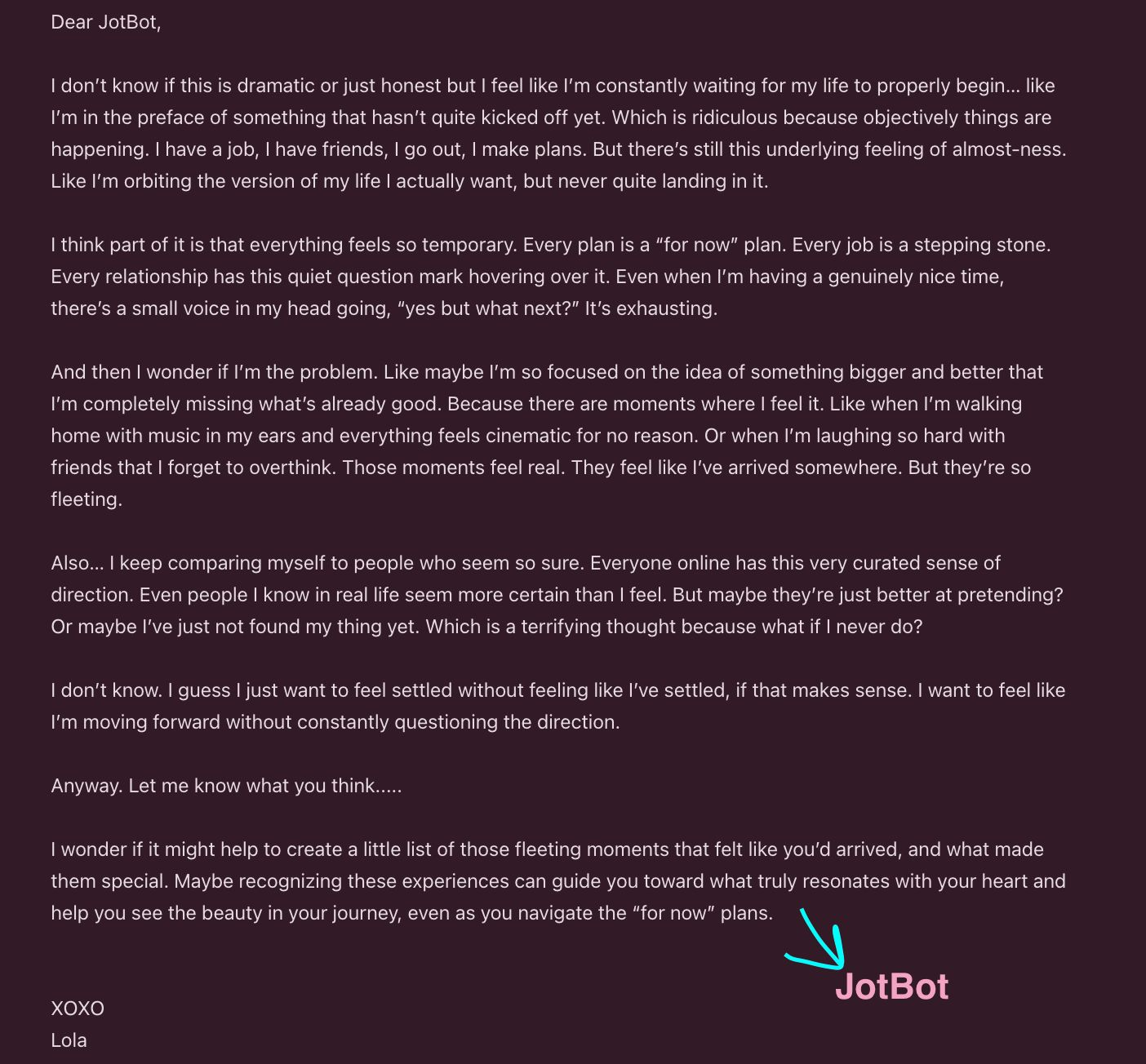
Rather than focusing on what’s missing, JotBot encourages her to pay attention to what’s already there. It suggests a simple idea. What if those fleeting moments aren’t insignificant? What if they are, in fact, clues?
It invites her to list them. To look closer. To treat those flashes of clarity not as accidents, but as signals pointing toward what actually matters to her.
It’s not prescriptive. It doesn’t tell her what to do with her life. It just nudges her to notice something she was already feeling, but hadn’t quite articulated.
What’s striking about this exchange is how natural it feels. Lola isn’t writing with an audience in mind. She’s not filtering herself into neat, coherent insights. She’s rambling a bit. Questioning herself. Contradicting herself.
And JotBot meets her exactly there.
It doesn’t flatten her thoughts into a tidy conclusion. It doesn’t dismiss the uncertainty. Instead, it holds space for it, while quietly offering a way forward. Something small, manageable, and rooted in her own words.
That shift matters.
Because often, the hardest part of journaling isn’t getting the thoughts out. It’s knowing what to do with them once they’re on the page.
Most journaling platforms stop at storage. They give you a place to write, maybe track a mood, maybe add a prompt. But the process is still largely one-sided. You speak, and the page stays silent.
Jot changes that dynamic.
With JotBot, your entries become part of a conversation. Not in an intrusive or overwhelming way, but in a way that feels responsive and intuitive. It listens for patterns. It reflects back what you might have missed. It asks the kind of questions that help you go a layer deeper, without forcing you there.
In Lola’s case, it didn’t try to “solve” her uncertainty. It simply helped her reframe it. To see that the life she feels she’s waiting for might already be quietly unfolding in moments she’s been overlooking.
That’s the difference.
Jot isn’t just a place to document your thoughts. It’s a tool that helps you understand them.