There is a version of journaling that exists in theory, and then there is the version most of us actually end up living, and the gap between the two is probably where most of the frustration comes from.
The theoretical version is calm and consistent and slightly aspirational, the kind where you sit down at the same time every day and reflect in neat, complete sentences, maybe even enjoying the process in a grounded, self-aware sort of way. The real version, at least for me, has never looked like that. It tends to happen at odd hours, usually when something has gone a bit wrong, or very wrong, and I suddenly feel like if I do not get whatever is in my head out of me and onto something else, it is just going to sit there and grow.
I have never really been someone who journals because things are going well. I journal because something isn’t.
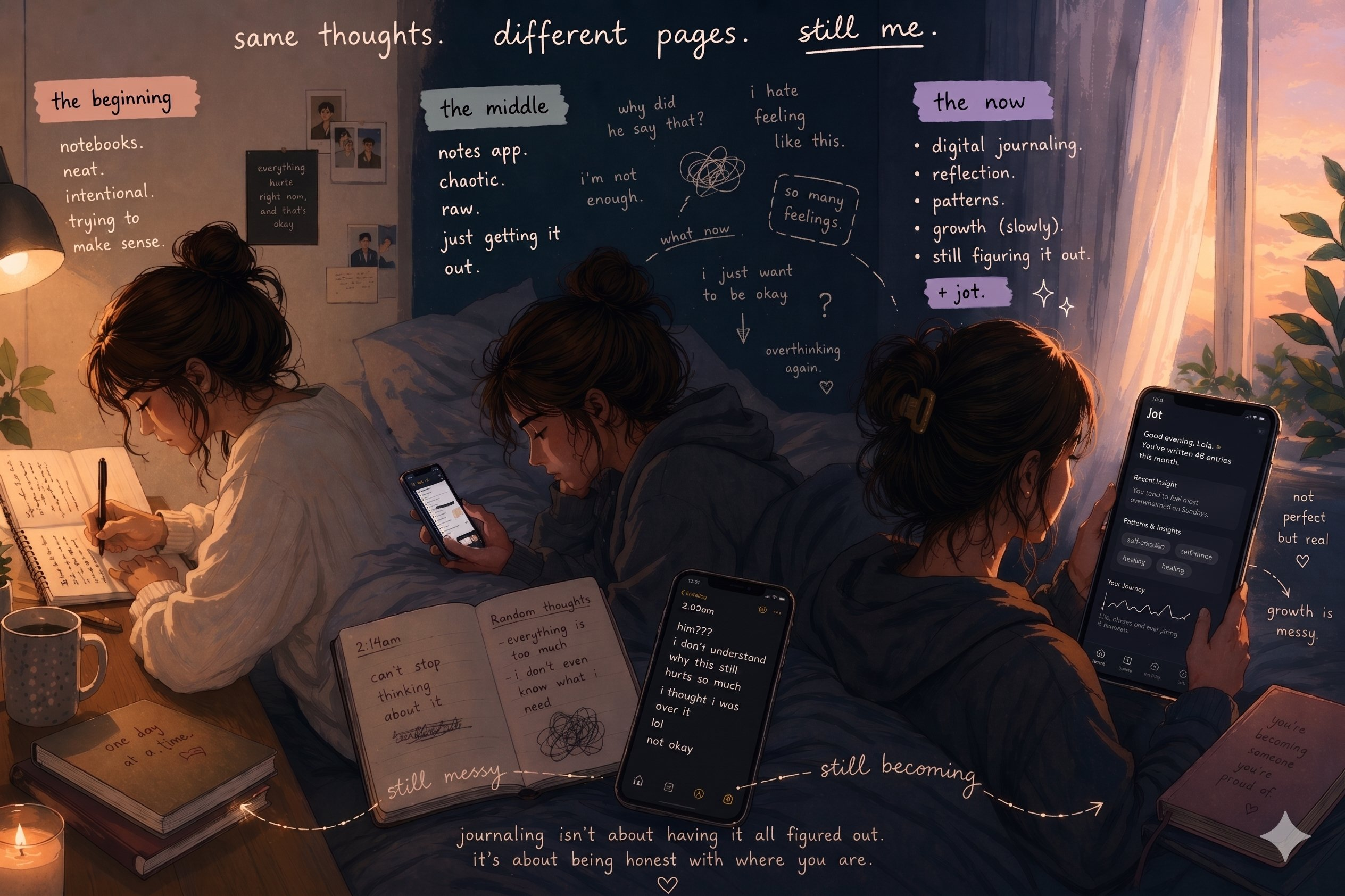
I can trace it back pretty clearly to my first breakup, which I remember less as a sequence of events and more as a long, suspended state where everything felt slightly unreal and difficult to move through. I was technically functioning, but only just, and there was this constant background noise of thoughts that I could not quite organise into anything coherent.
Journaling, at that point, stopped being a nice idea and became something closer to a necessity, not because I particularly wanted to write things down, but because I needed somewhere for those thoughts to go. It felt like the only place where I could start to separate out what I was actually feeling from the general fog of it all, even if what I was writing did not make much sense at the time.
There was nothing aesthetic about it. It was messy and repetitive and often circular, but it did something important, which was take the feeling out of my head and put it somewhere I could look at it, even if I did not fully understand it yet.
At some point, without really deciding to, I stopped using a physical notebook and started writing everything in my notes app, which in hindsight makes sense because my thoughts were never arriving at convenient, sit-down moments anyway. They were showing up late at night, or in the middle of the day when I was supposed to be doing something else, or immediately after a conversation that had left me feeling slightly off.
What followed was not exactly journaling in the traditional sense, but more like a collection of fragments. Half-finished entries, titles that only made sense in the moment, paragraphs that trailed off because I either got distracted or felt like I had said enough, even if I had not really reached any kind of conclusion.
It looked chaotic, and it probably was, but it also felt more honest than the notebook version, because I was no longer trying to make my thoughts presentable. I was just trying to catch them before they disappeared or turned into something harder to deal with.
The only issue was that, over time, it started to feel like everything was being stored but not necessarily processed.
This is the part I think gets overlooked when people talk about journaling as a solution to everything, because while it absolutely helps to get things out of your head, it does not automatically mean you have made sense of them.
My notes app became full of entries that captured exactly how I felt in a moment, but when I went back to them, they often felt like snapshots without context, like I was reading something written by a version of myself that I recognised but could not fully access anymore. I could see the emotion, but not always the pattern behind it, or why certain things affected me more than others, or what I was actually doing with any of that information.
What I realised, gradually, was that what I wanted was not just a place to put my thoughts, but something that could meet them halfway. Not in an intrusive or overbearing way, but in a way that made it easier to move from just expressing a feeling to actually understanding it.
When I started trying different digital journaling platforms, including jot, it was less about finding a perfect system and more about seeing whether the process itself could feel a bit more responsive.
What stood out was not that the experience was radically different, but that it removed some of the friction that had always made journaling feel slightly difficult to return to. Being able to write quickly, without setting anything up, and then come back to entries in a way that actually highlighted connections between them, shifted the experience from something purely reactive into something that felt, over time, a bit more reflective.
It did not suddenly make everything clear, but it made it easier to notice things I might have otherwise missed, which in itself felt useful.
There is a lot of advice about consistency when it comes to journaling, about building a daily practice and sticking to it, but the more I pay attention to my own patterns, the more I realise that my journaling has always been tied to intensity rather than routine.
I write when something is unresolved, when a thought keeps looping, when a feeling refuses to settle. Then, once things calm down, I stop, sometimes for weeks or months at a time, until the next moment arrives that requires the same kind of processing.
For a long time, I thought this meant I was doing it wrong, but now I am not so sure. It feels more accurate to say that journaling, at least for me, is not a daily habit so much as a response mechanism, something I return to when I need it, rather than something I maintain for its own sake.
If the act of journaling is about getting something out, then looking back is where you start to see what that something actually was, and how it has shifted over time.
There is something strangely grounding about reading old entries and realising that things you once found overwhelming have, in some way, resolved or at least softened. It is not always comfortable, and sometimes it is actively embarrassing, but it gives you a kind of perspective that is difficult to access when you are in the middle of something.
What I find myself wanting more and more is a way to see those patterns more clearly, not just as individual entries but as part of a larger emotional arc. The recurring themes, the shifts in tone, the moments where something starts to change even if you did not notice it at the time.
That kind of reflection feels less like journaling as an activity and more like journaling as a way of understanding yourself over time.
Even though the format has shifted, and even though I have moved between notebooks, notes apps, and different digital tools, the reason I keep coming back to journaling is still the same.
At some point, something becomes too much to hold internally, and writing is the easiest way to move it somewhere else.
It does not need to be neat. It does not need to be consistent. It does not even need to make complete sense. It just needs to exist outside of you long enough for you to look at it, question it, and eventually, if you are lucky, understand it a little better.
And if the process of doing that can be made even slightly easier, more intuitive, or more reflective over time, then it becomes something you are far more likely to return to, not because you should, but because it actually helps.
If you’re curious what a more responsive, more seamless version of journaling can feel like, you can explore it at getjot.ai.