a page from the jot journal ✦
August 4, 2026
From Brain Splat to Brilliant Plan: How Jot Can Organise your Entire Day from One Diary Entry
The best productivity system isn't another app. It's one place where everything starts making sense.
If you've ever run a business, you'll know the feeling.
You wake up at 6:43am with fourteen thoughts competing for your attention. You need to reply to a client. Book pilates for Thursday. Remember to order packaging before you run out. Message your graphic designer. Chase an invoice. Buy oat milk. Launch that Instagram Reel you've been thinking about all week.
By 7:15, you've opened your Notes app, your calendar, your reminders, WhatsApp, your email and three tabs you don't even remember clicking on. Somehow, before breakfast, you've already scattered your day across half your phone.
It feels productive, but it's really just organised chaos.
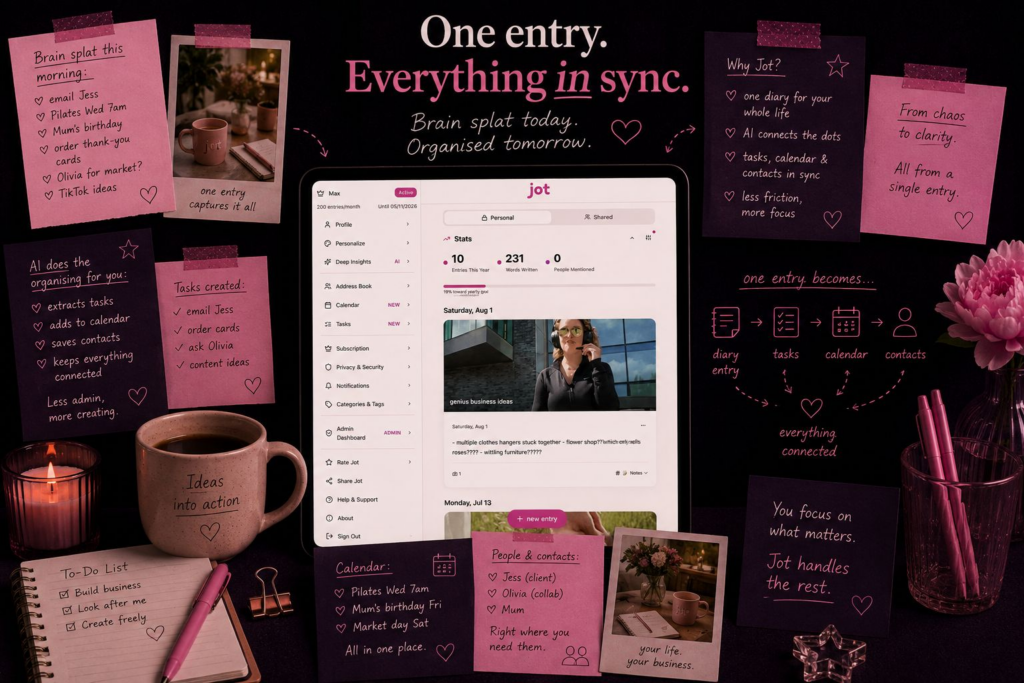
That's why we're so interested in bringing the diary back. Jot starts with something surprisingly simple: one diary entry. Write everything that's in your head exactly as it comes out, and let the AI do the organising afterwards. Instead of forcing yourself to think in categories before you've even had coffee, you can simply think, while your diary quietly sorts the rest.
Your Brain Was Never Designed to Think in Apps
One of the strangest things about modern productivity is that we've trained ourselves to categorise our thoughts before we've even had them.
"Is this a task?"
"Should this go in my calendar?"
"Do I need to email Sarah?"
"Should this be a reminder instead?"
The result is that every idea arrives with an administrative burden attached to it. Before you've even acted on the thought, you're already deciding where it belongs.
The brain doesn't work like that.
Ideas arrive as conversations with ourselves. Half-finished sentences. Tiny reminders. Random bursts of inspiration that make perfect sense in the moment and absolutely none two hours later.
A diary has always been the one place where you could think naturally. The difference now is that it can organise those thoughts for you afterwards.

Stop Writing for Software. Start Writing Like Yourself.
Imagine opening your diary and typing exactly what's going through your head.
"Need to email Jess about next week's photoshoot. Pilates class Wednesday at 7. Mum's birthday next Friday. Remember to order more thank-you cards. Ask Olivia whether she can help at the market. Need to brainstorm TikTok ideas."
No formatting.
No bullet points.
No categories.
No worrying whether something belongs in your calendar or on your to-do list.
Just one messy, very human brain splat.
That's all your diary needs.

Jot Connects the Dots While You Get On With Your Day
Once your entry is written, that's where jot starts doing the work.
The tasks hiding inside your thoughts can become actual to-do lists without you having to rewrite them. Dates you've mentioned can flow into your calendar, ready to keep your week on track. The people you've referred to can link to your address book, so client conversations, collaborators and friends stay connected to the moments they actually matter.
Nothing feels forced because you're not feeding information into half a dozen different systems. You're simply writing one diary entry and allowing everything else to grow from it.
The diary becomes the source of truth, rather than yet another place to remember.

Your Business Doesn't Exist in a Separate App
This is especially true if you're building something yourself.
Whether you run an Etsy shop, teach Pilates classes, freelance as a designer or are growing a startup from your kitchen table, work and life rarely stay in neat little boxes.
The idea for your next launch appears while you're walking the dog. Your client messages arrive while you're making dinner. You remember tomorrow's meeting while you're halfway through writing your shopping list.
Traditional productivity software expects you to separate all of those moments into different apps.
Real life never does.
A diary understands that your personal life and your professional life are part of the same story. Jot simply gives that story a structure, without asking you to change the way you naturally think.

Less Sorting. More Building.
Most productivity systems ask you to become an administrator of your own life.
Tag this.
Move that.
Copy this into another app.
Set a reminder.
Create another list.
Eventually you're spending as much time managing your organisation system as you are actually getting things done.
The beauty of jot isn't that it makes you work faster. It's that it quietly removes the tiny jobs that nobody enjoys doing in the first place, leaving you with more time to build your business instead of maintaining the software that's supposed to help you run it.

The Diary Is Becoming Your Operating System
For over two centuries, diaries have been where people made sense of their lives. They held ideas, appointments, reflections, ambitions and plans all in one place.
Technology didn't replace that idea. It fragmented it.
Now, for the first time, AI gives us the opportunity to put everything back together again.
Your diary doesn't just store your thoughts anymore. It understands them, connects them and helps turn them into action, making it the one place where your personal life, your business and your future plans can finally live together.
Your best ideas don't arrive neatly organised, so your diary shouldn't expect them to. Start with one messy entry, and let jot turn today's brain splat into tomorrow's plan.