July 28, 2026
How to Organise a Project Without Living in Five Different Apps
The best collaborations don't need more tools. They need one place where everything actually connects.
Starting a business with someone is exciting for about the first week.
After that, you discover you've accidentally built a second business whose sole purpose is keeping track of the first one.
Ideas are exchanged over WhatsApp. Meeting notes end up in Google Docs. Someone adds a date to Google Calendar but forgets to mention it in Slack. A client emails feedback, someone screenshots it, and before long you're asking the same question everyone asks at least once a day:
"Wait... where did we put that?"
Modern collaboration isn't usually difficult because people aren't organised. It's difficult because every conversation lives somewhere different.
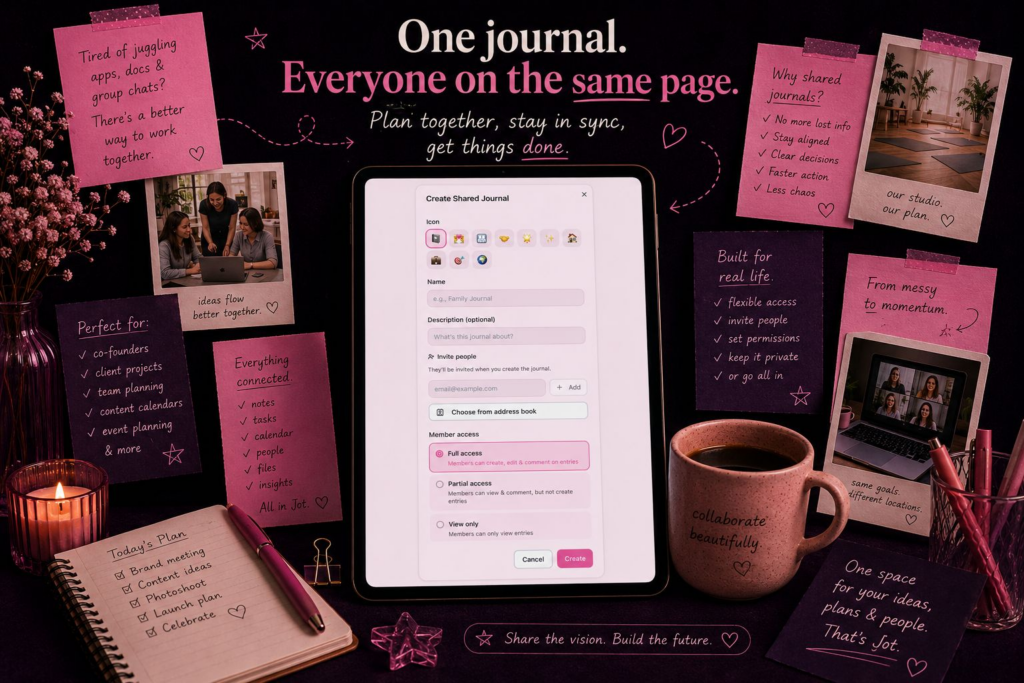
That's why we're seeing the diary make a comeback—not as a private notebook, but as a connected digital space where projects can actually live. With jot's shared journal, you can plan, brainstorm, record meetings, organise ideas and keep everyone on the same page, all inside the same diary that already holds the rest of your work and life.
Stop Thinking in Documents - Start Thinking in Stories
One of the biggest problems with traditional collaboration is that everything becomes fragmented almost immediately.
You have one document for meeting notes, another for launch ideas, a spreadsheet for tasks, a calendar for deadlines and a group chat where the most important decision somehow gets buried beneath pictures of someone's dog.
A shared diary works differently.
Instead of creating another isolated document every time something happens, every conversation becomes part of the same ongoing story. Your ideas evolve naturally because they're sitting beside the meetings that inspired them, the people involved and the actions that followed.
When you come back a month later, you're not piecing together a puzzle. You're simply picking the story back up where you left it.

Step One: Start a Shared Journal
Whether you're working with a co-founder, a client, your Pilates instructor team or even planning a pop-up with friends, creating a shared journal gives everyone one place to think together.
Rather than immediately opening three different apps, you start with the diary.
It's a surprisingly simple shift, but it changes the way collaboration feels.

Step Two: Brainstorm Without Losing the Good Ideas
Every founder knows the feeling of having a brilliant idea halfway through a conversation, only to realise nobody actually wrote it down.
Inside a shared journal, those moments don't disappear into chat messages or voice notes you'll never replay. They're captured where they belong, alongside every other conversation about the project, making it easy to see how an idea develops over time instead of wondering who first suggested it.
The diary becomes less like storage and more like a living workspace.

Step Three: Let Meetings Create Momentum
Meetings shouldn't generate another hour of admin.
Record your discussion with AI Meeting Notes, and jot automatically creates a transcript, identifies the key decisions and drafts clear meeting notes for everyone involved. Instead of copying actions into another app afterwards, those decisions stay connected to the project they're actually about, making it much easier to keep momentum going once everyone signs off.
Your diary doesn't just remember the meeting. It helps move the project forward.

Step Four: Let Your Plans Connect Themselves
This is where Shared Journals become something more than collaborative notes.
Mention a deadline and it can live alongside your calendar. Agree on next steps and they can become tasks. Discuss a client and they're already connected to your address book. Capture a new idea and it's still sitting there when you come back to plan next month's launch.
Everything feeds into everything else because it's all part of the same ecosystem.
Instead of constantly asking, "Which app should this go in?", the answer is almost always the same.
Your diary.

Who Is It Actually For?
The beauty of a shared diary is that it adapts to whatever you're building.
A Pilates studio can use it to plan class schedules and instructor meetings without endless email chains. An Etsy seller can collaborate with a photographer or illustrator on new product launches. Freelancers can keep client conversations, meeting notes and action points together instead of hunting through inboxes, while startup founders can brainstorm product ideas with co-founders without watching them disappear across Slack, Notion and half a dozen forgotten documents.
The business changes.
The workflow doesn't.

Collaboration Should Feel More Human
For years we've built our businesses across increasingly specialised software, each platform solving one tiny problem while quietly creating another.
The result is that collaboration often feels more like information management than working with other people.
The diary has always been different.
It's where plans become ideas, ideas become actions and actions become stories worth looking back on.
The only thing that's changed is that now, it doesn't have to belong to just one person.
Great businesses aren't built across a dozen disconnected apps. They're built through shared ideas, shared momentum and one place that keeps everything together. Start your first Shared Journal with jot and see what collaboration feels like when your diary becomes your workspace.