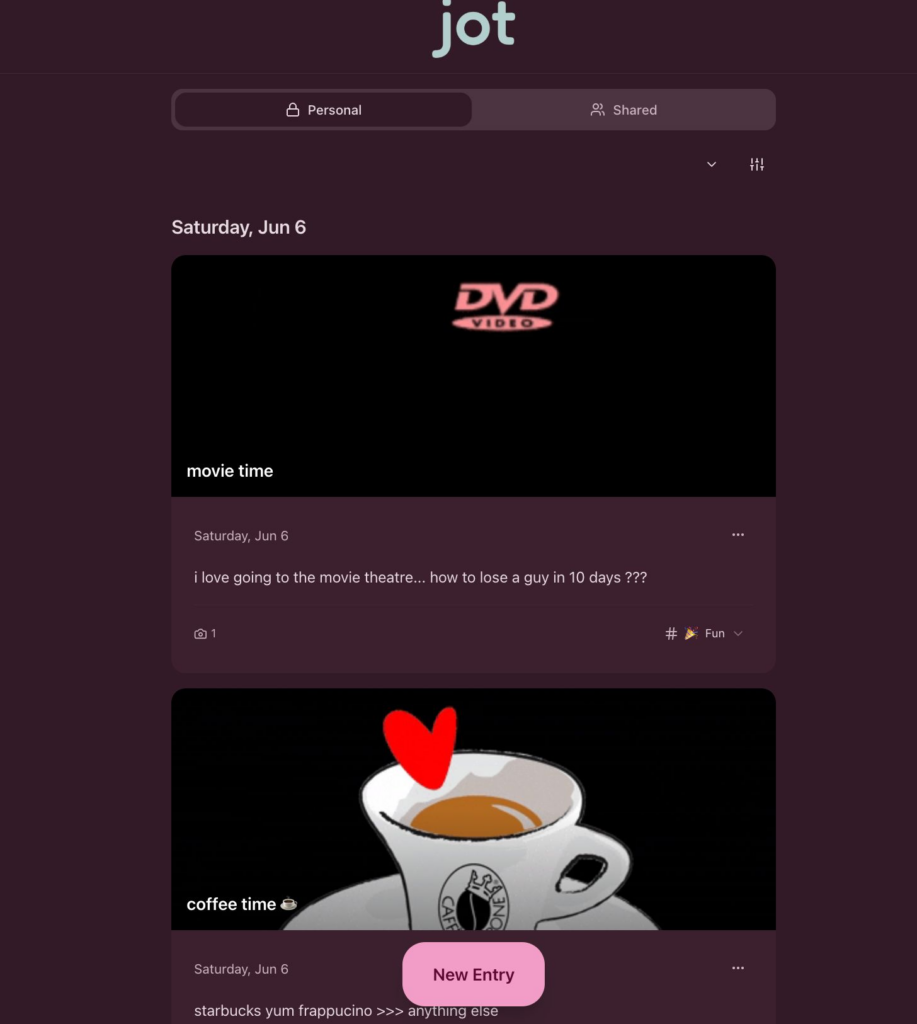
a page from the jot journal ✦
June 8, 2026
Nostalgia Is Having a Digital Glow-Up: Why We're Bringing Back the Diary Instead of Letting It Die
I've become slightly obsessed with the fact that so much of modern technology seems to be looking backwards.
At a time when we're supposedly racing towards AI, self-driving cars, and whatever comes after smartphones, some of the biggest cultural trends seem strangely preoccupied with the recent past. People are buying digital cameras that produce grainy photos on purpose. Teenagers are decorating their phones like it's 2004. Pinterest is full of glitter graphics, chunky fonts, and scrapbook layouts that would have looked completely normal on a teenage girl's bedroom wall twenty years ago. Even newer products like jot, which is trying to reinvent the diary for the digital age, lean into customisation and personality rather than the sterile minimalism that dominated tech for so long.
Even the internet itself seems nostalgic for a version of itself that no longer exists.
The easy explanation is that people find comfort in familiarity, especially during uncertain times. There's probably some truth in that. But I don't think we're nostalgic for old technology so much as we're nostalgic for how it felt to use it. The early internet was often clunky and inconvenient, but it was also intensely personal. You could spend hours customising your MySpace profile, choosing songs that represented your entire personality, or painstakingly arranging photos on a page that looked absolutely horrific from a design perspective. None of it was efficient, but that wasn't really the point. It felt like you were building a little corner of the internet that belonged to you.
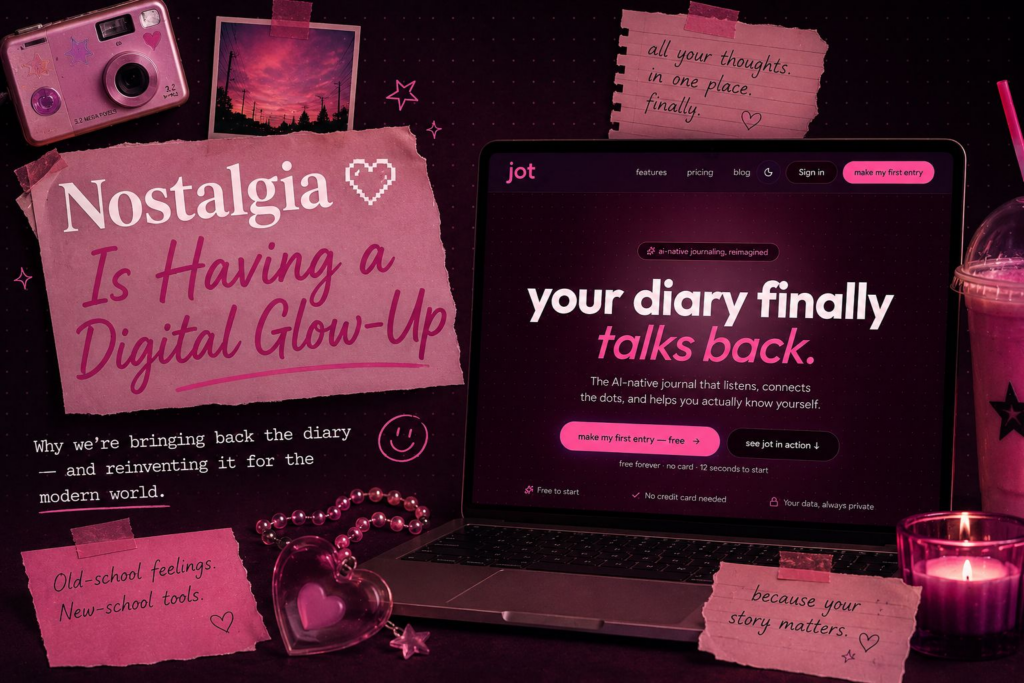
The Internet Used to Feel More Personal
Modern technology has become infinitely more sophisticated, but in many ways it has also become more uniform. Most apps are beautifully designed and remarkably intuitive, but they often feel interchangeable. We spend our lives moving between calendars, notes, messages, photos, reminders, workspaces, and social feeds, all while feeling slightly less connected to ourselves than when we started.
There is something slightly ironic about this. We have more tools than ever to organise our lives, yet many people feel as though their lives are scattered across dozens of different systems. A memory lives in Photos. A plan lives in Calendar. A thought lives in Notes. A conversation lives in WhatsApp. A feeling disappears entirely because there was nowhere obvious to put it.
In trying to optimise everything, we've accidentally fragmented ourselves.
The Diary Never Really Went Away
This is why the diary has proved remarkably difficult to kill.
For centuries, people have turned to diaries for essentially the same reason. Not because they wanted to create a historical record of their day, but because they were trying to make sense of what was happening to them while it was still happening.
The funny thing is that most people still do this now.
They just don't call it journaling.
The midnight Notes app entry after a breakup. The voice memo recorded during a long walk. The screenshots saved for reasons that feel important at the time but are difficult to explain later. The endless lists, half-finished thoughts, and emotional brain dumps scattered across a phone.
Those are diaries too.
They're simply fragmented diaries.
What We're Actually Nostalgic For
Whenever people talk about bringing back the diary, they often imagine a leather notebook, beautiful handwriting, and the kind of consistency that exists mostly in films.
The reality is much messier.
Most of us don't miss the physical object itself. We miss having a dedicated space for reflection. We miss feeling like our thoughts have somewhere to land. We miss the sense that there is one place capable of holding the different parts of our lives together.
That is why nostalgia is so powerful. It isn't about wanting to return to the past exactly as it was. It's about identifying something valuable that has been lost and figuring out how to carry it forward.
Why Digital Diaries Feel Different This Time
For years, digital journaling was often positioned as a replacement for the traditional diary. The implication seemed to be that technology would somehow improve the experience simply by existing.
That never felt particularly convincing.
The interesting question isn't whether a diary should be physical or digital. The interesting question is whether it can solve the problems created by modern life.
Platforms like jot are compelling because they're trying to answer that question. Rather than treating journaling as a standalone activity, they're rebuilding the diary around the way people already think and live. Voice notes, reflections, memories, plans, conversations, emotional patterns. Instead of scattering those things across multiple apps, the idea is to bring them back together again.
In a strange way, that's actually closer to the original purpose of the diary than many traditional journals ever were.
Making Old Ideas New Again
The most successful technologies rarely replace old ideas. More often, they absorb them.
Maps became sat-navs. Cameras became smartphones. Letters became messaging apps. The core human need remained exactly the same while the format evolved around it.
The diary is going through a similar transformation.
We're not watching journaling disappear. We're watching it adapt to a world where people think differently, communicate differently, and carry their entire lives around in their pockets.
Which is why nostalgia and innovation aren't opposites at all.
The most interesting products today aren't abandoning the past. They're figuring out which parts of it are worth preserving.
And perhaps that's why the diary feels so relevant again. Not because we're returning to an old habit, but because we're finally rebuilding it for the way we live now.
The diary isn't making a comeback. It never left. We're just reinventing it for the digital age. Explore the next chapter at getjot.ai.