a page from the jot journal ✦
September 29, 2026
Six People, Six Ways to Use Jot: What Does Your Life Need From a Diary?
You might be a student with three deadlines, a founder with 47 tabs open, an athlete chasing a new personal best, or simply someone trying to remember what they did last Tuesday. Jot is designed to fit around your life, rather than asking your life to fit around it.
There is a strange expectation that a diary should be one very specific thing. You write about your feelings, you reflect on your day – maybe you keep a little record of what happened, make a few observations about yourself and occasionally look back at old entries wondering who on earth you were in 2023.
But real life is considerably messier than that.
Sometimes your diary is where you process a difficult week. Sometimes it is where you remember that you need to email someone. Sometimes it is where you plan your next big idea, keep track of your training, write down a meeting or dump seventeen completely unrelated thoughts before they disappear.
That is the idea behind jot. It is not designed around one type of person or one perfect journaling routine. Every type of person is dealing with a completely different kind of chaos, but the underlying problem is remarkably similar: there is a lot going on, and you need somewhere for all of it to go.

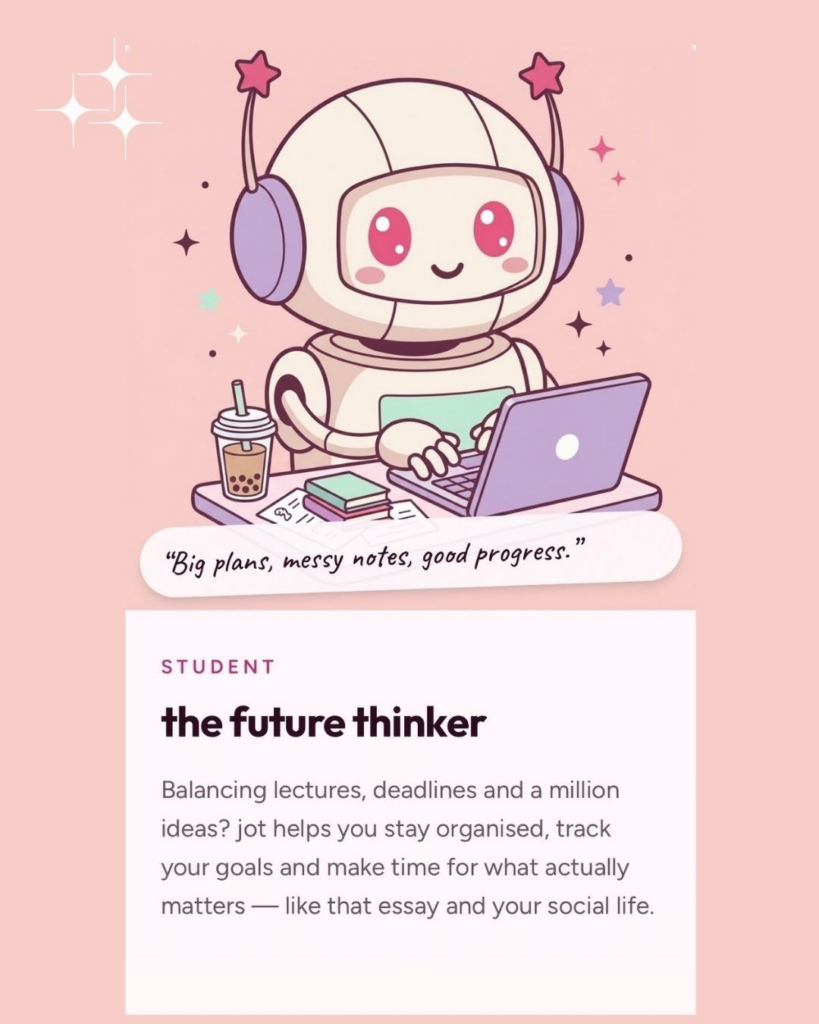
The student: when your brain is basically one giant open tab
Being a student is often presented as a relatively simple equation: attend lectures, do the work, pass the exams.
In reality, it is more like trying to run a small company without the funding, the employees or the functioning sleep schedule.
There are essays, seminars, deadlines, social plans, part-time jobs, societies, birthdays, housemates and approximately 400 thoughts about what you might do after graduation. Jot can become the place where those things actually meet, helping you keep track of deadlines and plans while still leaving room for the less productive but equally important parts of being a person.
You might start with a completely chaotic entry about everything you need to get done this week and turn those thoughts into something more manageable. You might use a template when you cannot quite work out what you are feeling, keep a gratitude habit going, or simply write about the fact that your dissertation has once again become your entire personality.
The point is not to turn studying into a productivity Olympics. It is to have somewhere that can hold both “I have an essay due on Friday” and “I really need to see my friends because I have been living in the library.”
Both are relevant information.
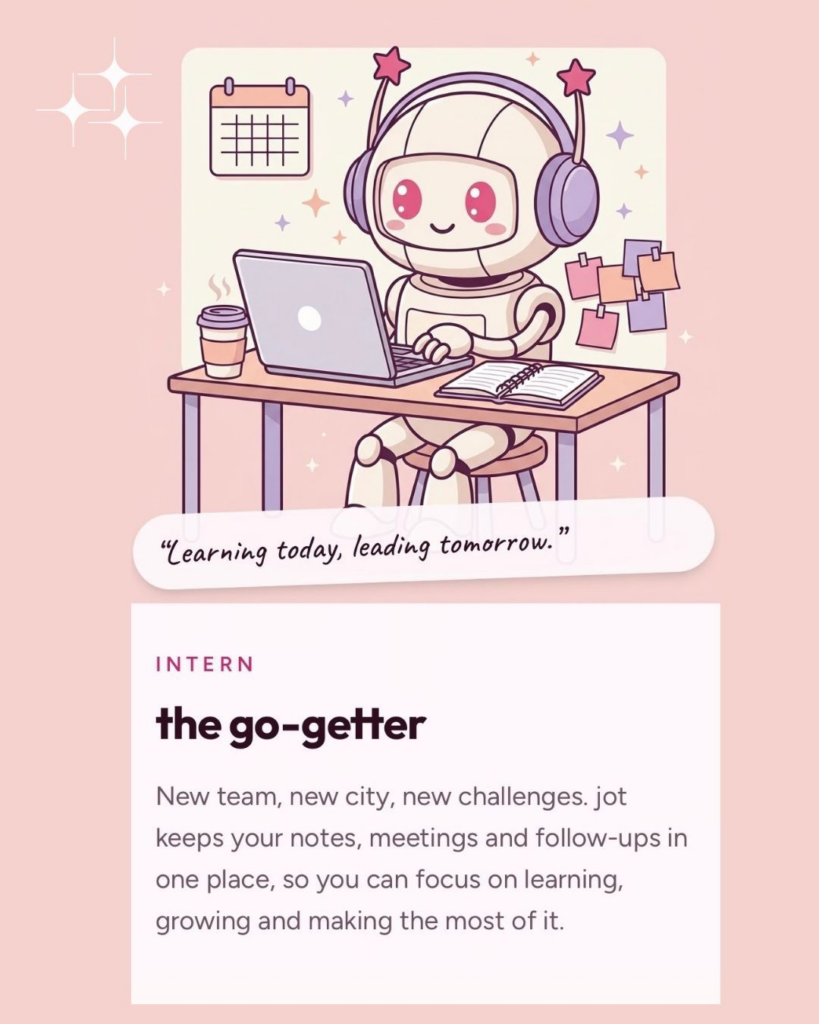
The intern: when everything is new and you are trying to remember all of it
Starting a new job is a particular kind of information overload.
There are new names, new systems, new meetings, new acronyms that everyone apparently understands except you and approximately fourteen things you thought you would remember but absolutely will not.
For an intern or someone early in their career, jot can become a place to capture all of those moving pieces without having to decide immediately where every thought belongs. Meeting notes can be organised, people can be saved in your address book, ideas can become tasks and follow-ups can actually make it out of your brain and into the world.
It also means your diary can become a record of the experience itself.
What did you learn today? What did your manager say? What idea did you have in that meeting? What did you want to ask but completely forgot? What are you proud of?
Six months later, those entries become more than a collection of notes. They show you what you were learning, what kept coming up and how much changed while you were busy trying to look like you knew what you were doing.
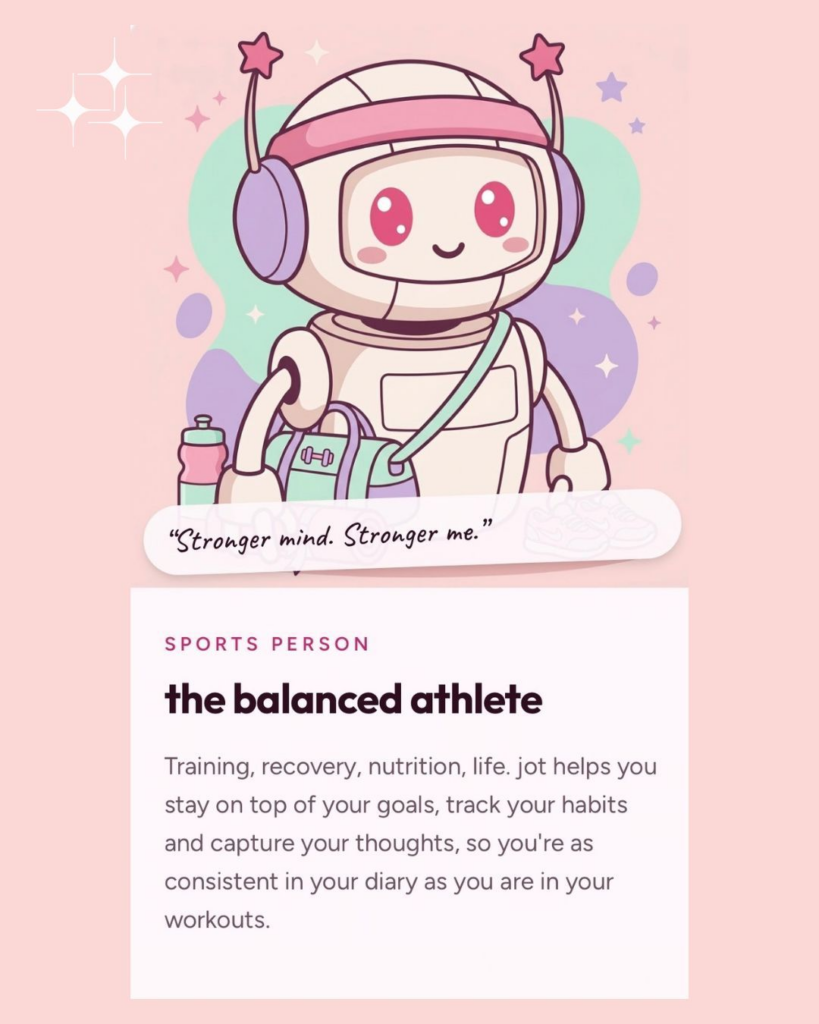
The athlete: because your life does not stop at the gym
There is a tendency to treat fitness as something that can be neatly measured: distance, time, weight, reps, pace.
Human beings are slightly less straightforward.
You can have a brilliant training week and feel exhausted. You can hit a personal best and still have had a terrible day. You can be completely motivated on Monday and wonder why you ever decided to take up running by Thursday.
Jot gives athletes somewhere to record the rest of the picture, including habits, goals, mood and energy alongside their routines.
That makes the diary less about obsessively tracking whether you hit every target and more about understanding what your life actually looks like around those targets.
Maybe your best training days tend to follow better sleep. Maybe you always lose motivation when your schedule gets too crowded. Maybe your mood changes when your routine does.
Over time, jot's deeper insights can help surface patterns across your entries, giving you a chance to notice connections that are difficult to see when you are simply moving through each day.
Your workout tells you what happened.
Your diary can help you understand the context.
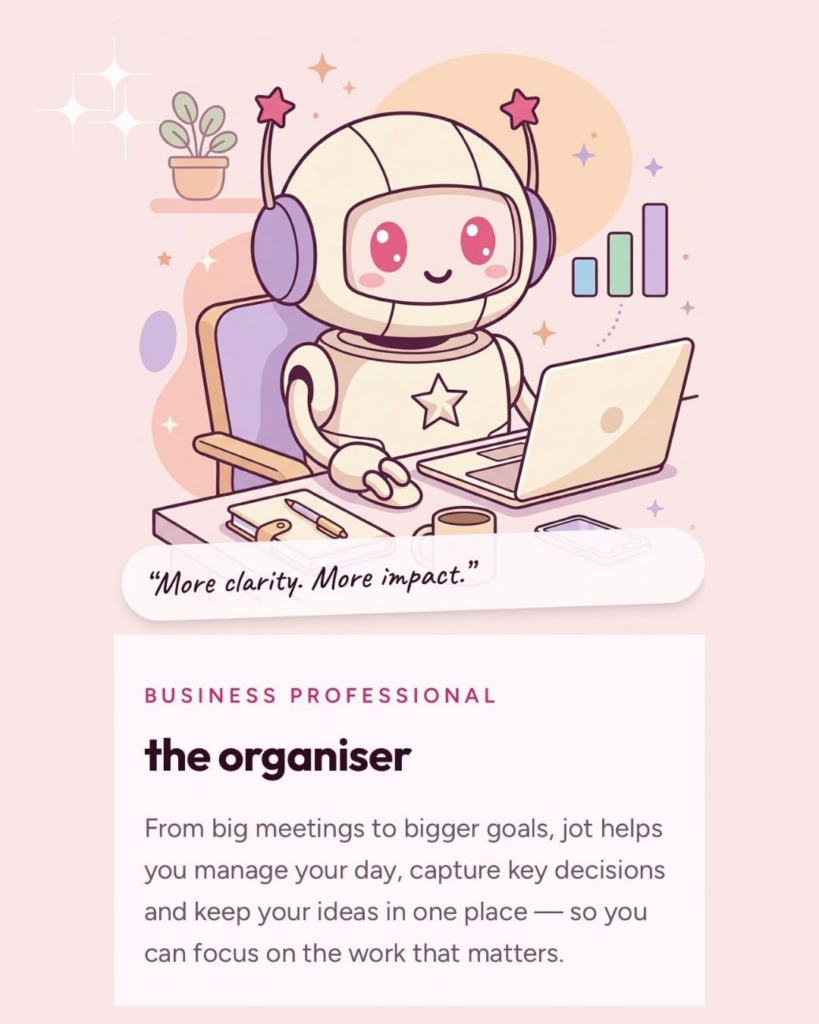
The business professional: when every meeting ends with another meeting
Then there is the person whose calendar looks like it was designed by someone actively trying to prevent them from having lunch.
For business professionals, Jot can sit between the thinking and the doing. You can sync your calendar, keep track of contacts and turn meeting notes into actions, rather than allowing every useful idea from a meeting to disappear into a document called.
Jot's AI Notes can also transcribe meetings, pull out key decisions and create action items, meaning you can spend more of the meeting actually participating instead of frantically attempting to write down every sentence someone says.
And because those notes live alongside the rest of your diary, the separation between “work stuff” and “life stuff” becomes a little less rigid.
Which is probably more realistic anyway.
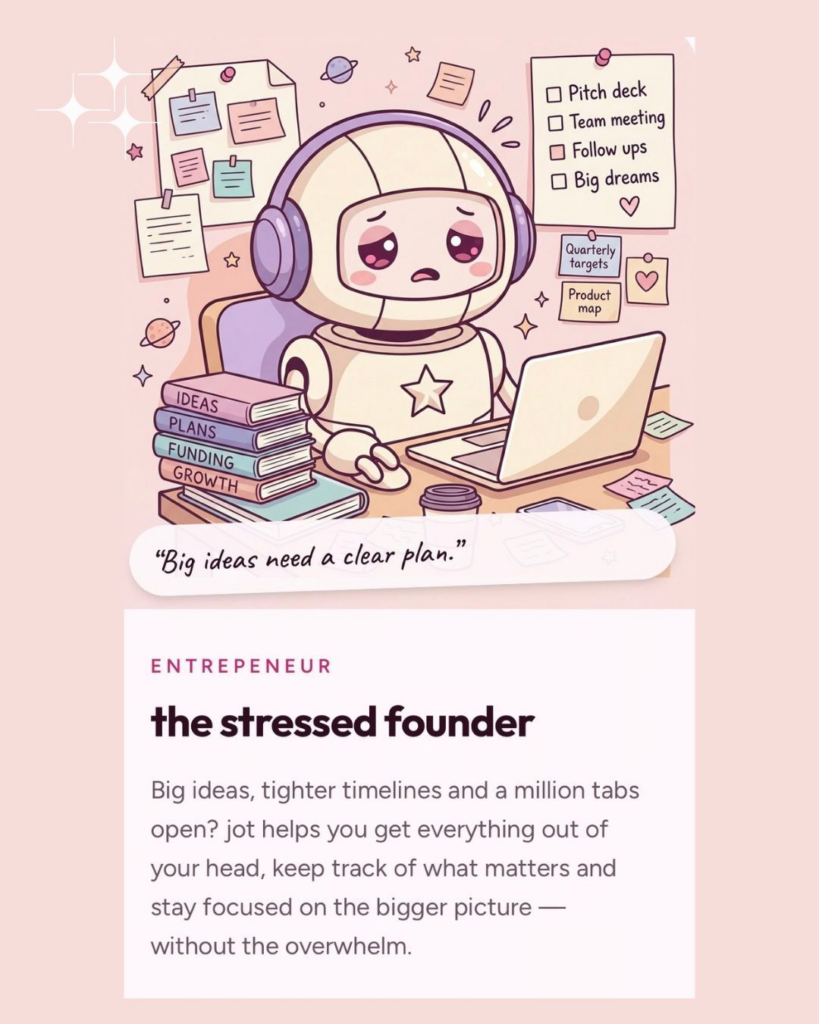
The founder: when your entire brain is a project management system
Founders have a particularly annoying version of the information problem.
There is the business, obviously. Then there are clients, meetings, ideas, suppliers, plans, deadlines, finances, contacts, follow-ups and approximately 900 tiny things that you have decided you will definitely remember.
You will not remember.
This is where jot's ability to turn an unstructured brain dump into useful information becomes particularly relevant. A founder can start by writing everything down as it comes to them, then use jot to help connect thoughts with tasks, calendar events, contacts and follow-ups.
The important part is that the starting point does not have to be organised.
You can write:
Need to email Sarah. Also meeting Thursday. Website copy still terrible. Need to call accountant. Had an idea for the launch. Mum's birthday next week. Why have I agreed to another meeting?
It is still a diary entry.
But instead of leaving those thoughts sitting there, jot can help turn them into the things you actually need to remember and do.
For someone whose brain is simultaneously their diary, calendar, project manager and slightly unreliable personal assistant, that can make a meaningful difference.
The mindful one: when the point is simply to check in
And then there is the person who does not want their diary to become another productivity system.
Maybe their goals are less about getting more done and more about understanding how they are actually doing.
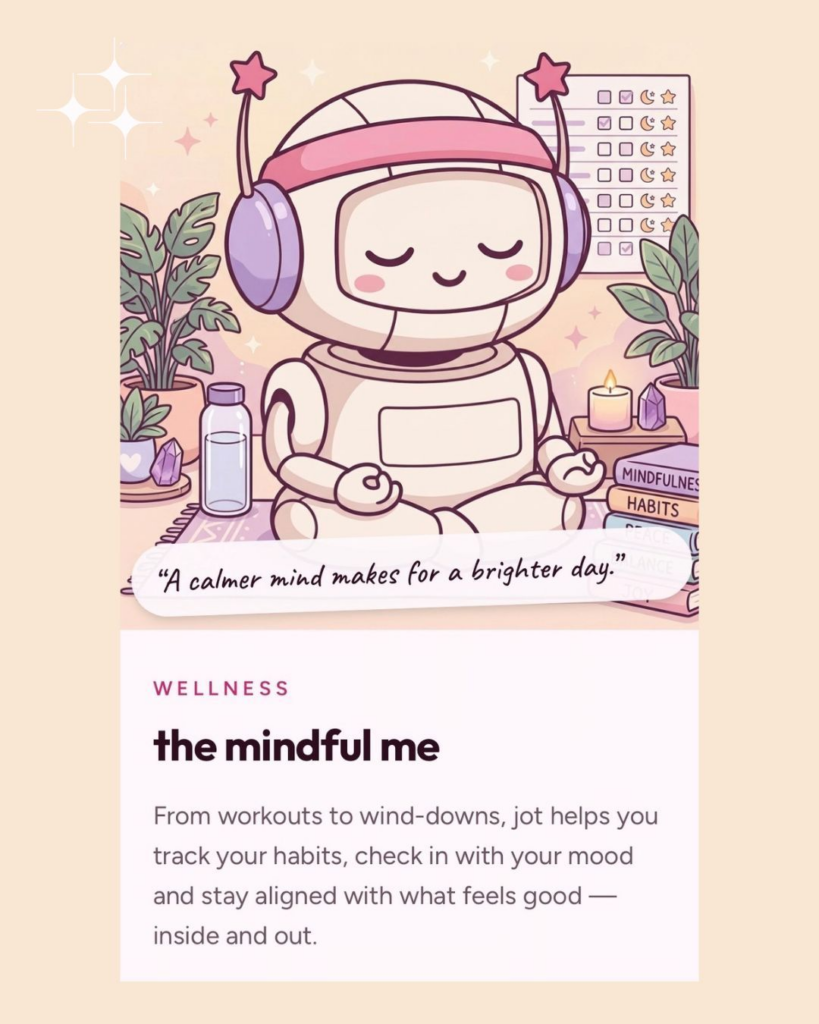
Jot's wellbeing-focused side can be used to track habits and goals, log mood and energy, build routines and create space for reflection.
Templates can also make that process easier when staring at a completely blank page feels like an oddly intimidating experience. Instead of having to invent something profound to write about, you can start with a simple prompt and see where it takes you.
There is something useful about having a diary that can accommodate both versions of you: the person who wants to organise the week down to the last calendar event and the person who just needs ten minutes to sit down and admit that they are tired.
You do not have to turn every feeling into an action point.
Sometimes noticing it is enough.
Maybe the point is that you do not need one type of diary
That is really what all six jot personas have in common.
The student, intern, athlete, professional, founder and mindful journaler might have almost nothing else in common on paper. Their schedules are different, their priorities are different and the things they need from their diary are different.
But none of them live in one neat category.
The student might also be training for a marathon. The athlete might be running a business. The founder might be trying to remember their friend's birthday. The business professional might need somewhere to process a difficult day. The intern might suddenly decide to start a side project.
Real life refuses to stay in its little labelled boxes.
So your diary should not have to either.
Jot gives you one place for the thoughts, plans, people, tasks, memories and little details that make up your life, while letting you decide how much structure or AI you actually want.
Whatever your life looks like right now, jot can keep up. Make jot yours →