July 1, 2026
We're Living Through the Death of Memory (And Nobody Has Noticed Yet)
We've never documented our lives more. So why does it feel like we're remembering less?
We've outsourced our memories. We just haven't realised it yet.
The average person probably remembers less than they think they do.
Not because our memories are getting worse, but because we've quietly handed the job over to technology. Every day, without really noticing, we outsource another small piece of ourselves to an app that promises to remember it for us.
Our phones remember birthdays. Our calendars remember appointments. Spotify remembers the songs we played on repeat during that strange month when we couldn't stop listening to the same album. Google Maps remembers where we parked the car. Instagram reminds us where we were exactly three years ago today. Even our search history remembers questions we've long since forgotten asking.
We've become remarkably good at storing information. The strange thing is that we've become much worse at storing meaning. If you've ever wished there were one place where your thoughts, plans, memories and reflections could actually live together, rather than being scattered across half a dozen apps, that's exactly the problem jot was built to solve. It takes the idea of the traditional diary and reimagines it for the way we live now, bringing your life back into one connected story.
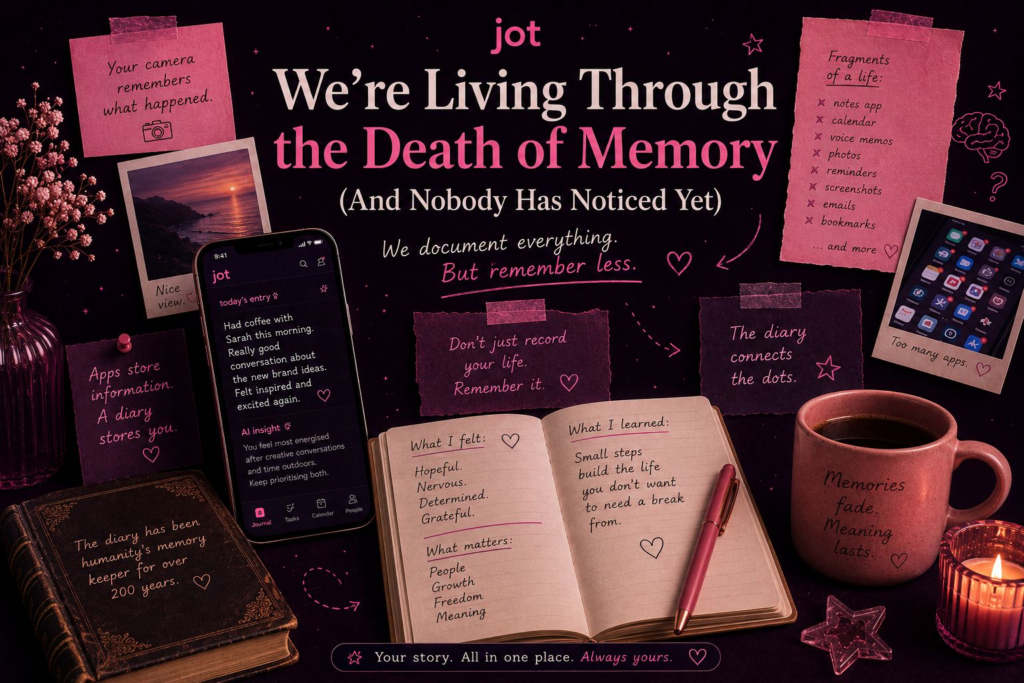
Our lives are documented in extraordinary detail, yet they often feel oddly difficult to piece back together. We can scroll through thousands of photos from a holiday and still struggle to remember what we were actually thinking while we were there. We can find the exact message we sent someone two years ago, but not remember why that conversation mattered in the first place.
Memory, it turns out, isn't just about keeping information. It's about connecting it.
If you look closely, that's exactly what the traditional diary always did. It wasn't valuable because it recorded every event. It was valuable because it recorded how those events felt while they were happening.
Your camera remembers what happened. Your diary remembers who you were.
Think about the last time your phone surfaced one of those automatic photo memories.
You probably smiled. You might even have forgotten the day entirely until the notification appeared. But after a few seconds of looking through the pictures, there is often a strange feeling that something is missing. The photographs show where you were and who you were with, but they rarely tell you what was going on inside your head.
Were you happy? Nervous? About to make a decision that would completely change your life? Were you secretly heartbroken while smiling for the camera? Had you just landed your dream job, or were you counting down the days until you quit it?
The photos don't know.
Neither does your calendar.
Neither do your emails.
That is what diaries have always preserved better than any other technology. They capture not just the facts of a life, but the perspective of the person living it.

Somewhere along the way, we broke our lives into pieces.
Modern life has become surprisingly fragmented.
Your work meetings live in one app. Your to-do list lives in another. Your contacts live somewhere else. Voice notes, reminders, screenshots, bookmarked TikToks, saved Instagram posts, random Notes app entries, unread emails and forgotten documents all exist independently of one another, each holding a tiny fragment of your life.
The irony is that every one of these apps claims to make us more organised. Individually, many of them do. Together, they leave us constantly switching between systems, trying to reconstruct the bigger picture ourselves.
Perhaps that's why the idea of the diary suddenly feels relevant again. Not because people are nostalgic for leather-bound notebooks, but because the diary has always offered something that modern technology accidentally lost. It brings the story back together.
That is one of the ideas behind jot. Rather than asking you to think about whether something belongs in your notes, your calendar, your task manager or your contacts, it starts from a much simpler premise: that your life is connected, so your diary should be too.
The future of memory isn't about storing more. It's about understanding more.
One of the most interesting shifts happening in technology isn't that AI can generate information. It's that AI is becoming increasingly good at recognising patterns.
Imagine writing regularly for six months and discovering that every time you mention feeling overwhelmed, work deadlines and poor sleep appear in the same entries. Imagine realising that your happiest weeks consistently involve seeing certain friends, spending time outside, or working on creative projects that you had almost forgotten about.
These aren't facts you would necessarily notice while living through them. They only become visible when someone, or something, can step back and look at the bigger picture.
For centuries, people have reread old diaries hoping to find those connections for themselves. AI doesn't replace that process. If anything, it helps reveal patterns that might otherwise remain buried beneath hundreds of pages of everyday life.
The diary begins to feel less like an archive and more like a conversation with your past self.
We don't need more memories. We need better ones.
There is a quiet misconception that remembering more automatically means remembering better.
In reality, memory has never been about quantity. Most of us couldn't tell you what we had for lunch on a Tuesday three years ago, and that's probably for the best. What matters are the moments that changed us, the relationships that shaped us, and the small patterns that explain why we became the people we are now.
The problem is that these moments rarely announce themselves while they're happening. They often look completely ordinary at the time. A conversation over coffee. A long walk after work. The first week in a new city. The last normal day before everything changed.
Those moments only become significant in hindsight, which is exactly why keeping a diary has always mattered.

The diary has always been a memory machine. It's just becoming a smarter one.
When the first Letts diaries were created in 1812, they solved a very human problem. People needed somewhere to keep the story of their lives.
More than two hundred years later, that need hasn't disappeared. If anything, it has become more urgent. We have never had so much information competing for our attention, yet so few places where it all comes together.
The modern diary isn't replacing your calendar, your contacts or your notes. It is giving them context. It is turning disconnected information back into something that resembles a life.
Perhaps that is why the diary is having such an unexpected renaissance. Not because people suddenly want to write with fountain pens again, but because they are looking for one place that remembers not just what happened, but why it mattered.
If your memories are scattered across a dozen different apps, perhaps it's time to bring them back together. Start your first diary entry with jot and discover what your story looks like when everything finally connects.