July 20, 2026
Why Every Meeting Ends with a Notebook Full of Gibberish (And How to Finally Stop Taking Notes)
Somewhere between "Can everyone hear me?" and "Any other business?", we've all accidentally stopped paying attention.
There are few modern workplace experiences more universally shared than pretending to listen while frantically trying to write everything down.
Someone mentions a deadline. Someone else suggests an idea you'll definitely want to remember later. Three people start talking at once. You scribble something that looks vaguely like "marketing... Thursday... Sarah??" and reassure yourself you'll make sense of it afterwards.
You won't.
Forty-eight hours later, you're staring at a page that reads like it was written during a mild earthquake, trying to remember whether "blue arrows" was a brilliant strategic insight or simply the moment your pen slipped off the page.
It's a strange way to spend meetings, especially when the whole point is supposed to be having conversations. Instead of listening properly, asking better questions or building on someone else's idea, most of us are busy producing increasingly unintelligible notes that we'll have to decipher later.
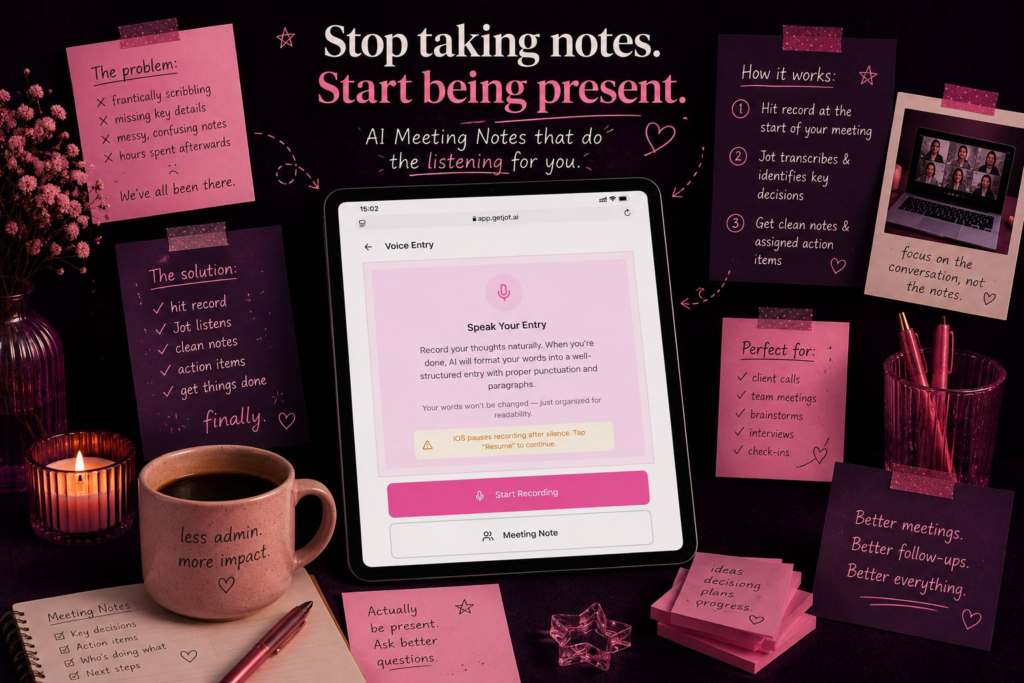
Thankfully, we're starting to outgrow this particular workplace ritual. With jot's AI Meeting Notes, you simply hit record at the beginning of a meeting and let your diary do the remembering. It captures the conversation, creates a full transcript, pulls out the important decisions, drafts clean notes and highlights the action points, leaving you free to do the thing you were actually invited to the meeting for: taking part in it.
Meetings Were Never the Problem. The Admin Afterwards Was.
People love to complain about meetings, but meetings themselves aren't usually the issue. It's everything that happens once they've finished.
There's the ritual of translating your handwritten notes into something another human being could actually read, followed by the inevitable game of detective as you try to remember who volunteered to do what. You send a follow-up email, create a to-do list, realise you've forgotten one of the key decisions entirely, and spend the next week wondering whether anyone else remembers it either.
By the time you've finished organising the meeting, you could almost justify holding another meeting about the first one.
Multitasking Is Mostly Just Doing Two Things Badly
For years we've convinced ourselves that listening and note-taking happen simultaneously, when in reality we're just switching our attention backwards and forwards at remarkable speed.
You catch half a sentence because you're still writing down the last one. You miss the follow-up question because you're trying to spell someone's surname correctly. The best idea of the meeting arrives just as you're underlining something that suddenly doesn't seem important anymore.
It's hardly surprising that so many meetings leave us feeling like we've been present without really being present at all.
Removing note-taking from the equation changes the atmosphere almost immediately. Conversations become conversations again, rather than endurance events where everyone is quietly competing with their own handwriting.
Your Diary Should Remember the Meeting So You Don't Have To
This is where the idea of the diary becomes much more interesting than a collection of disconnected productivity apps.
A meeting isn't just another transcript sitting in a folder you'll never open again. It's part of the ongoing story of your work, connected to the people involved, the projects you're building and everything that happens next.
Inside jot, that single recording becomes far more than a block of text. The conversation is transcribed automatically, the important decisions are surfaced, and the action points are clearly assigned, before flowing naturally into your wider diary. Tasks can become actual to-dos, meeting dates stay linked to your calendar, and the people you've spoken to are already sitting in your address book, which means everything stays connected instead of disappearing into half a dozen different apps.
It's less about creating another productivity tool and more about finally giving your work a memory.

Three Steps. Zero Scrambling.
Using AI Meeting Notes is refreshingly uneventful, which is exactly the point.
You hit record before the meeting begins, carry on with the conversation without worrying about capturing every detail, and when it's over jot has already done the heavy lifting. Your transcript is ready, your notes are organised, the key decisions are easy to scan, and the action points are waiting for you instead of hiding somewhere in the margins of a notebook.
It's the sort of technology that quietly disappears into the background, which is usually a sign that it's doing its job well, leaving you relaxed and unburdened by the horrors of unfettered admin.

The Best Productivity Hack Isn't Working Faster. It's Paying Better Attention.
For all the talk about AI replacing work, some of its most useful applications are surprisingly simple.
Nobody dreams of spending their afternoon rewriting meeting notes or trying to remember who promised to email the client. Those tasks have never been the valuable part of work; they've just been the unavoidable admin that followed it.
If AI can quietly take those jobs off your plate, what you're left with is something much more valuable: the space to think, contribute and actually enjoy the conversation you're having.
Which, when you think about it, is probably what meetings were meant to be all along.
Your diary shouldn't just remember what happened – it should help you act on it. Try jot's AI Meeting Notes and see what happens when your meetings stop generating admin and start generating momentum.