July 13, 2026
Why Running a Small Business Shouldn't Mean Running Twelve Different Apps
From Pilates instructors to Etsy sellers, modern entrepreneurs are expected to wear every hat. The problem isn't the workload – it's where we keep it all.
There comes a point in almost every small business where you realise you're spending almost as much time managing your systems as you are managing your business.
Your calendar tells you where you're supposed to be, your Notes app contains the idea you had at 2am, your to-do list has grown into something slightly terrifying. Client details are buried in WhatsApp conversations, invoices live in another platform entirely, and somewhere, hidden among hundreds of screenshots, is the branding inspiration you swore you'd come back to.
Individually, none of these tools are bad, but together, they leave your business feeling scattered.
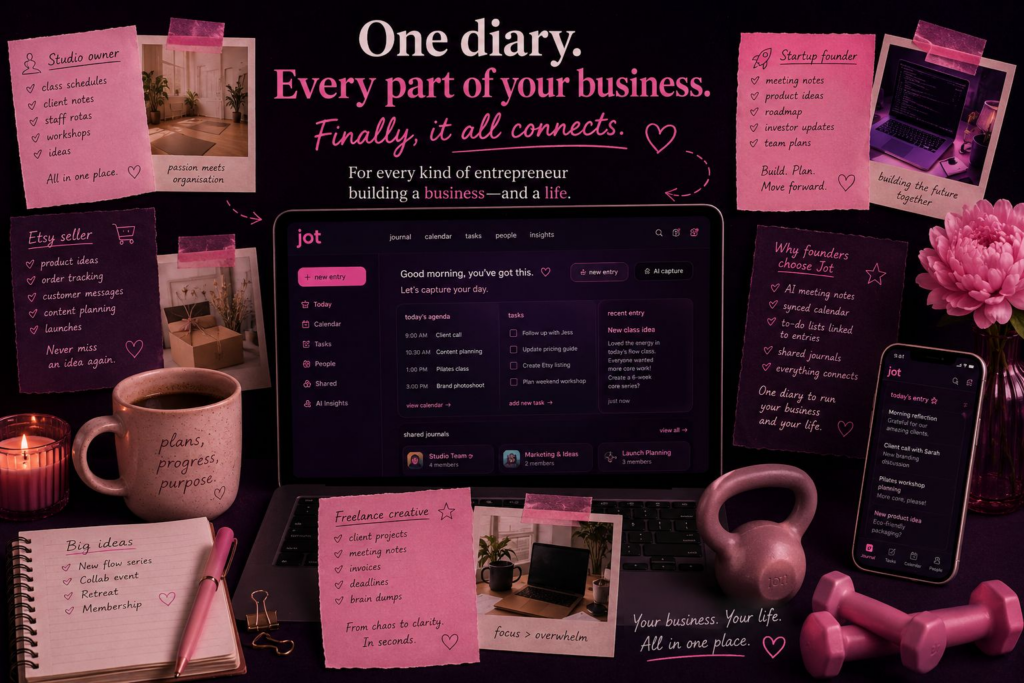
It's one of the reasons we're seeing a quiet return to the diary. Not the paper diary tucked into a desk drawer, but a digital one that understands your work and your life aren't two separate things. Jot brings your thoughts, meetings, plans, contacts and calendar together in one place, giving founders somewhere to build their business without constantly jumping between apps.
Because whether you're selling handmade jewellery or building the next AI startup, every business begins with one thing: an idea worth remembering.
The Pilates Studio Owner Who Somehow Became an Administrator
If you've ever run a Pilates or yoga studio, you'll know that teaching classes is only half the job.
The rest of your week disappears into replying to emails, following up with clients, remembering who mentioned a shoulder injury last month, planning new classes, organising instructor rotas and trying to fit your own life somewhere in between.
A diary-first approach makes all of those moving parts feel connected again. You might finish teaching a class and immediately jot down a few reflections about how it went, note that several clients asked for an evening session, and record ideas for a new beginners' course. Those thoughts don't disappear into a forgotten note. They stay connected to your calendar, the people involved and the actions that come next.
If you're working with another instructor or studio manager, a shared journal becomes an easy place to plan schedules, brainstorm events or keep everyone updated without long email chains.

The Etsy Seller Whose Best Ideas Arrive at the Worst Times
Creative businesses rarely work nine to five.
Your best product idea might arrive while you're making dinner. You suddenly think of the perfect Christmas collection during a dog walk. A customer sends feedback that sparks an entirely new product range.
The problem isn't having ideas but trusting yourself to remember them.
A digital diary lets every spark live alongside everything else happening in your business. Sketch out a collection, make rough notes about pricing, add thoughts on marketing, and let those entries naturally evolve into tasks and reminders without having to rewrite everything elsewhere.
Instead of wondering where you saved that idea, you simply know where your business lives.

The Freelance Creative Who Is Constantly Switching Hats
One hour you're pitching a new client.
The next you're editing content, sending invoices, chasing payments, preparing for tomorrow's meeting and somehow trying to remember to buy groceries on the way home.
Freelancing has a funny way of making every day feel fragmented.
This is where AI begins to feel genuinely useful rather than gimmicky. Meeting notes can become clear summaries with action points already pulled out for you. A rough brain dump can be organised into manageable tasks. Conversations with clients stay connected to the projects they're actually about, while your calendar and to-do list update alongside everything else.
Instead of maintaining separate systems, your diary becomes the place where work actually happens.

The Startup Founder Building Something Bigger
Tech founders spend their days making decisions.
Product meetings, investor conversations, customer interviews, feature requests, hiring plans, launch strategies.
Every conversation creates more information, and before long that information is scattered across Slack, Notion, Google Docs, voice notes and half a dozen meeting transcripts.
Imagine opening one diary entry after a product meeting, recording your thoughts while they're still fresh, letting AI turn those notes into action points, automatically creating follow-up tasks, linking them to the people involved, and keeping the entire story of the project in one place. Your co-founder can jump into the same shared journal, add their own reflections, expand the agenda for the next meeting and keep momentum going without anyone wondering where the latest version lives.
It doesn't replace collaboration. It simply makes collaboration feel connected.

The Best Businesses Aren't Built on Better Apps – They're Built on Better Systems.
One of the biggest misconceptions about productivity is that successful founders use more software.
In reality, they usually use fewer tools more intentionally.
Every time you switch between apps, you lose a little momentum. Every time an idea ends up in the wrong place, there's a chance it never gets acted on. Every time you have to remember where you saved something, you're spending energy that could have gone into growing your business instead.
The diary has quietly solved this problem for more than two centuries. It has always been the place where ideas became plans, plans became actions and actions became stories.
The difference now is that it can do far more than hold your thoughts. It can connect them.
Bring your ideas, meetings, tasks and ambitions together in one place with jot. Start your first diary entry and discover what running a business feels like when everything finally connects.