a page from the jot journal ✦
August 10, 2026
Your Brain Is Not a Project Management Tool: How to stop carrying your entire business, calendar and personal life around in your head
There is a particular kind of mental clutter that comes with being ambitious. You can be halfway through replying to a client when you remember you need to book a dentist appointment, which reminds you that your friend's birthday is next week, which somehow reminds you of an idea you had for your business three days ago, which you absolutely must write down before it disappears.
So you open your phone, add something to your Notes app, flag an email, put another thing in your calendar and tell yourself you'll deal with the rest later.
This is what we like to call being organised.
The problem is that none of those things are actually connected.
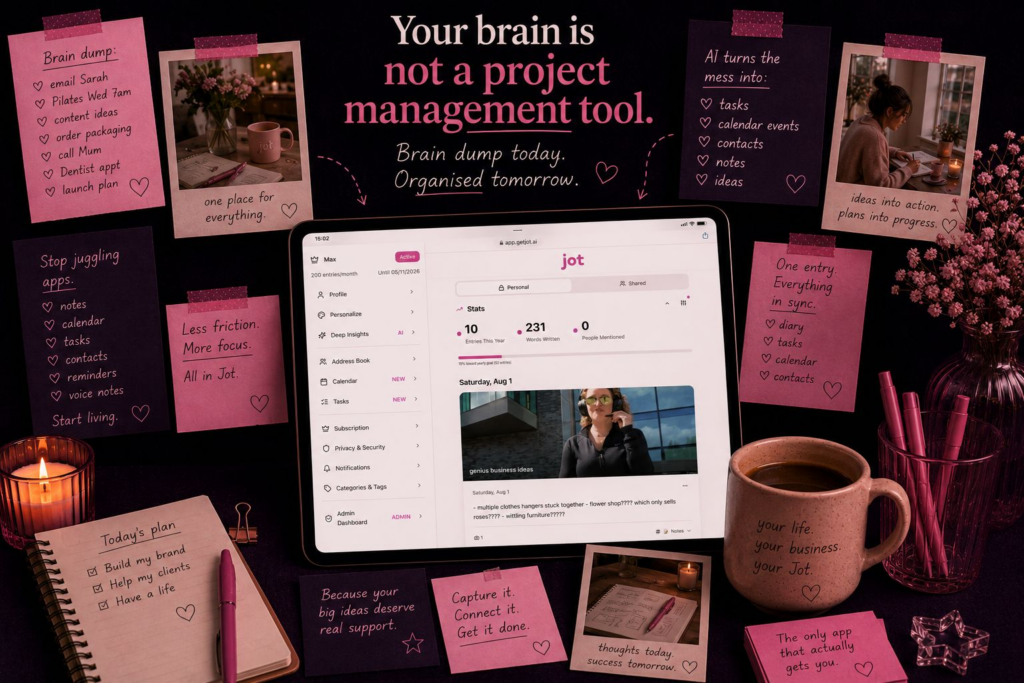
With jot, you can start with the mess instead. Write down whatever is currently taking up space in your head, whether that's a business idea, a reminder to call someone, plans for the weekend or a slightly panicked list of everything you have forgotten to do, and let AI help turn it into something useful.
The Brain Dump Is Having A Comeback
There is something oddly freeing about writing everything down without worrying about where it belongs.
You don't need to decide whether something is a task, calendar event, contact, idea or diary entry before you write it. You can just get it out.
That's where the old-fashioned diary was always surprisingly good. You could write "email Sarah about the launch" directly underneath "Mum's birthday Friday" and somehow both pieces of information made perfect sense because they were part of the same life.
The difference now is that jot can actually do something with the mess.
A thought can become a task, an appointment can connect to your calendar, a person can be pulled into your address book and an idea can stay attached to the entry where you originally had it. Instead of spending twenty minutes organising the organisation system, you can get back to whatever you were actually trying to do.
Your To-Do List Should Know Why You're Doing The Thing
A traditional task list is useful, but it can also be completely divorced from reality.
"Email Emma."
Great. Who is Emma? Why are you emailing her? What did you discuss last time? Is this urgent? Was this connected to the project you were thinking about yesterday?
Your diary knows.
That context is arguably more valuable than the task itself, particularly when you're running a small business and your personal and professional worlds constantly overlap. Jot keeps those connections together, so the task isn't floating around on its own like an orphaned reminder.
The Calendar Is Only Half The Story
A calendar can tell you when something is happening, but it doesn't necessarily tell you what it means.
A 2pm meeting could be a casual catch-up, a pitch that you've been stressing about for a week or the conversation where you finally decide whether you're launching that new idea you've been thinking about.
When your calendar, entries, contacts and tasks can work together, your schedule starts to reflect your actual life rather than simply showing a series of coloured boxes.
And that is a much more useful kind of organisation.
Let AI Deal With The Admin You Keep Promising You'll Do
This is probably where AI is most useful in everyday life: not generating a 700-word LinkedIn post about the future of female entrepreneurship, but quietly dealing with all the tiny organisational jobs that you keep putting off.
Jot can take the raw material of your day and help turn it into something structured, while keeping the original context and thoughts intact.
You can brain-dump in the morning, capture ideas throughout the day, use shared journals to collaborate, record meetings, and then let everything feed back into the same ecosystem of tasks, calendar events and contacts.
You provide the thoughts.
Jot does the filing.

Maybe The Goal Isn't To Become More Organised
For people building businesses, side hustles, creative projects or simply trying to keep their lives vaguely under control, organisation can start to feel like another job in itself. Maybe the answer isn't becoming the sort of person who colour-codes their entire existence and has a beautifully curated productivity dashboard for every conceivable scenario. Maybe it's having somewhere to put everything, and technology clever enough to work out what to do with it afterwards. Because your brain was designed to have ideas, make connections and occasionally remember something extremely important while you're shampooing your hair.
Ready to get the chaos out of your head?
Start your next entry in jot, brain-dump freely, and let AI turn your thoughts into something you can actually act on. Your brain has enough to do already.