September 21, 2026
Your Digital Life Is Personalised... So Why Does Your Diary Look Like Everyone Else’s?
There is something extremely distinct about the amount of effort Gen Z puts into making the digital world feel like theirs.
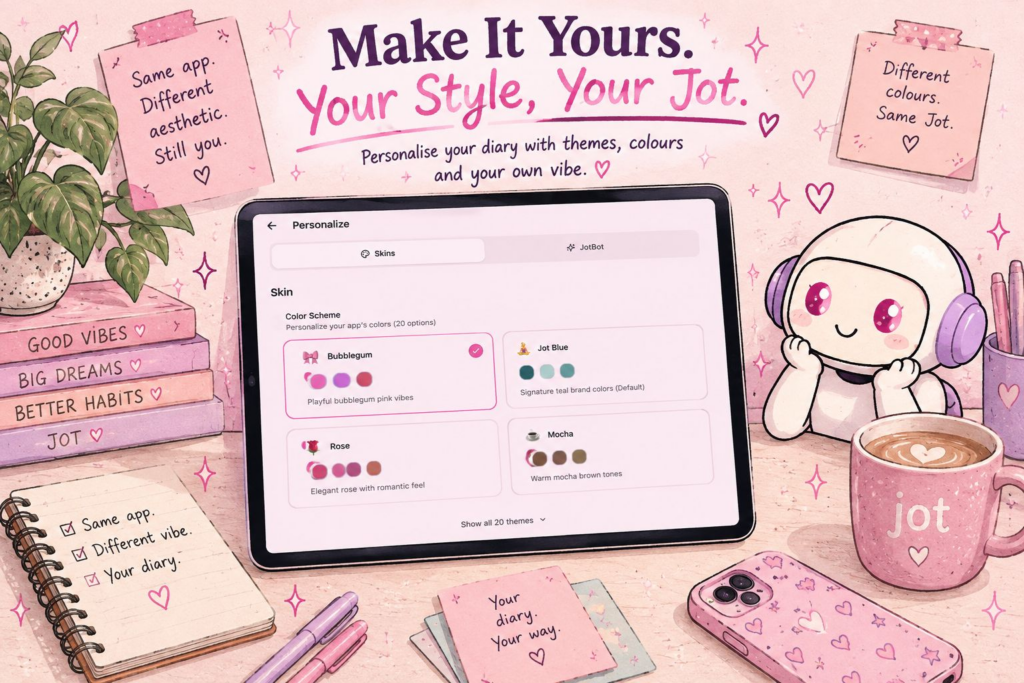
Your phone wallpaper has a very specific vibe; your Instagram feed has a colour palette; your Spotify playlists have names that are either deeply sincere or completely incomprehensible; your Pinterest boards have been curated with the precision of a museum exhibition. You play with different skins and versions of JotBot on jot. You might even have spent an unreasonable amount of time choosing the right widgets for your home screen.
And then you open your diary app and it looks like a piece of enterprise software.
Why?
We have become very good at making the internet look like us
For Gen Z, digital spaces are not simply functional. They are places where identity gets expressed, experimented with and constantly adjusted. Research into digital identity has found that online environments play a significant role in how young people explore and present different versions of themselves.
That makes sense when you think about how much of everyday life now happens through screens.
In one 2023 Roblox survey of Gen Z users in the US and UK, 56% said styling their avatar was more important to them than styling themselves in the physical world.
Aesthetics have become their own language, too. “Core” aesthetics, visual trends and highly specific digital styles have become a recognisable part of Gen Z culture.
So it feels slightly odd that so many of the apps we actually use every day still look like they were designed to be used by somebody called David in an office with grey carpet.
Your diary should not feel like a spreadsheet
The problem with most productivity software is that it starts with the assumption that everyone wants the same thing: efficiency. Clean interface. Neutral colours. Three columns. Tiny icons. Perhaps a reassuring shade of blue. Very useful. Very sensible. Very little personality.
But a diary is different.
A diary is supposed to be a reflection of your life, which means it should be allowed to have some personality of its own. It should be somewhere you actually want to open, not another digital filing cabinet you have reluctantly agreed to maintain.
That is part of what makes jot different. It lets you personalise the look and feel of your diary with different skins, while also allowing you to choose how JotBot communicates with you. You can make the experience feel softer, brighter, calmer or simply more like something you would voluntarily spend time in.
And yes, this is technically a product feature.
But it is also about something bigger: ownership.
Your diary can change because you change
The version of you who downloads jot in September might not be the same person using it six months later.
Maybe right now you are in your productivity era, colour-coding your life and convincing yourself that waking up at 6am is about to become a personality trait.
Then winter arrives and your diary becomes somewhere to dump your thoughts at midnight.
Then you start a new job.
Then you decide to run a half marathon.
Then you become obsessed with cooking.
Then you realise you have accidentally spent three weeks writing about the same person.
That is the point of a personal diary. It changes because you change.
Jot is designed around that flexibility. You can write normally, use templates when you want a little more direction, talk instead of type, share journals with other people, or use JotBot when you want some help making sense of what you have written.
It does not have to look or work exactly the same every day.

And personalisation is more than picking a shade of pink
The best kind of personalisation is not just cosmetic.
It is about being able to use something in the way that makes sense to you.
Some days, you might want to sit down and properly reflect. Other days, you might have approximately seventeen thoughts at once and need somewhere to throw them before they disappear.
Jot can handle both.
You can use templates to give yourself somewhere to start. You can use voice entry when typing feels like too much effort. You can write completely freely. You can use JotBot's different personalities if you want a more conversational experience, or switch its AI assistance off if you would rather have the diary entirely to yourself.
The important thing is that the technology adapts to you.
Not the other way around.
The useful stuff happens behind the aesthetic, too
Because jot is not just trying to make journaling prettier.
It is trying to make the diary useful enough to become part of your actual life.
Write that you need to call someone and jot can help connect that information with your contacts. Mention something happening next Tuesday and it can connect with your calendar. Brain-dump everything you need to do and jot can help turn those thoughts into tasks. Record a meeting and it can transcribe the conversation, identify decisions and pull out action points.
So you get the nice bit and the useful bit.
The pink diary can also be the place where your calendar, tasks, people, plans and thoughts actually meet.
Which feels considerably more interesting than another app that simply lets you change the background colour.
We don't need more apps that tell us who to be
There is already enough pressure online to perform a version of yourself.
Your feed can become a personal brand. Your productivity app can turn your life into targets. Your wellness app can tell you how you should be feeling. Even the supposedly “authentic” corners of social media can end up becoming another carefully constructed aesthetic. Recent commentary has pointed to exactly this tension: even messy, supposedly unfiltered online expression can become another form of performance.
Your diary should be one place where you do not have to perform.
It can be pretty because you like pretty things. It can be chaotic because your brain is chaotic. It can be highly organised because you love a system. It can contain serious reflections, ridiculous thoughts, half-finished ideas and the occasional entry that is just: “I genuinely cannot deal with today.”
All of those are valid diary entries.

Your digital space should feel like your space
The point of personalisation is not to make your diary Instagrammable.
It is to make it feel familiar enough that you want to come back to it.
Jot gives you the flexibility to decide what that looks like, while quietly handling the organisational stuff around your entries when you want it to. Your diary can be reflective without being restrictive, aesthetic without being superficial, and useful without turning every thought into a productivity exercise.
Because if almost every other part of your digital life can have your personality all over it, why shouldn't your diary?
Make jot yours. Choose your look, choose your level of AI, write however you want and let your diary evolve with you.